The manufacturing sector remains one of the highest-risk environments for workplace incidents. As we move through 2025, several risks continue to dominate HSE incident reports, while new emerging hazards are shaping how businesses must respond. Understanding these risks and addressing them early is essential for protecting workers, maintaining compliance, and strengthening operational resilience.
In this 2025 review, we break down the most critical risks in manufacturing, what recent Safety Management Critical Risk Audits reveal about root causes, and how organisations can reduce incident likelihood through stronger controls, training, and assurance.
Why Critical Risk Management Matters in 2025
Manufacturing workplace injuries often involve high-energy hazards — meaning incidents can be severe, life-altering, or fatal. In the last three years, manufacturing has consistently remained one of the top sectors for serious workplace harm, with key risks including:
- Contact with machinery
- Being struck by moving vehicles or objects
- Falls from height
- Exposure to harmful substances
- Fire and explosion events
These risks are preventable — but only if they are identified, quantified, and actively managed through structured audit and risk control systems.
Top Critical Risks in Manufacturing (2025 Overview)
1. Machine Safety & Guarding Failures
Machinery remains the highest-impact risk. Injuries often occur where machine guards have been removed, isolation procedures are unclear, or maintenance happens informally without LOTO controls. In many audits, physical safeguards exist but supervision and verification do not.
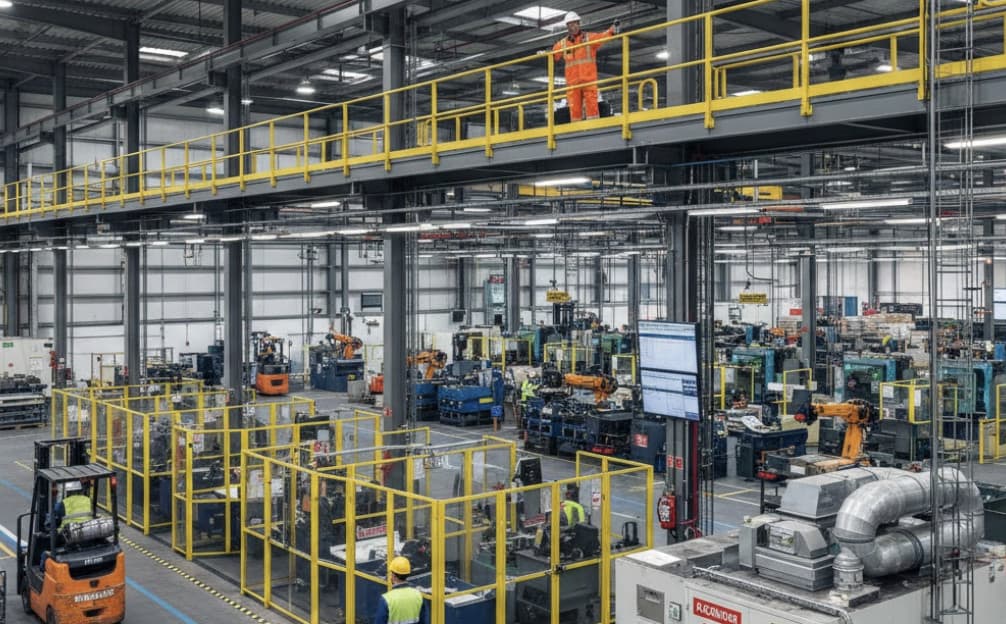
2. Workplace Transport & Forklift Interactions
Vehicle-pedestrian collisions are still one of the highest-impact risks across factory floors and yards. Key contributing factors include:
- Poor segregation routes
- Confusing walkways and crossing points
- Inadequate reversing controls
- Fatigue, pace pressures, and informal shortcuts
In many audits, the issue isn’t the absence of procedure but low adherence.
3. Manual Handling Leading to MSD Injuries
Many manufacturing environments still rely on repetitive manual lifting. Poor ergonomics, limited mechanical assistance, and pace-pressure create long-term injury risk that quietly erodes workforce capability over time.
4. Hazardous Substances (COSHH)
Chemical exposure, fumes, particulates and coatings continue to present significant illness-based risk. Typical audit findings include:
- COSHH assessments outdated or generic
- Control measures in place, but not verified
- LEV systems untested or undocumented
In 2025, emphasis shifted from control exists to control proven, measured and evidenced.
5. Electrical, Fire & Explosion Risk
Flammable materials, dust build-up and ageing electrical systems leave room for high-severity incidents if unchecked. Many of the highest-risk sites are those with irregular review cycles and little proof that preventive controls still work.
6. Work at Height & Fragile Surface Risk
Access platforms, racking, roof work and maintenance at height continue to contribute to fatal accident rates. The biggest failings are rarely in equipment, but in planning, including insufficient rescue arrangements, temporary solutions and informal workarounds.
7. Contractor & Permit-to-Work Weaknesses
Short-term contractors introduce risk quickly when permit validation is inconsistent. Audits frequently find permits signed off without competence checks or adequate supervision during high-risk work.
What Our Critical Risk Audits Are Revealing in 2025
Across manufacturing environments, three themes appear repeatedly:
1. Controls exist — but aren’t monitored
Many sites have good paperwork, but lower operational adherence.
2. Supervision & assurance make or break risk effectiveness
Unsafe shortcuts emerge when oversight fades.
3. Where audits occur, performance improves
Regular critical risk audits drive measurable risk reduction in as little as 3–6 months.
How Manufacturers Can Reduce Critical Risk Exposure
The greatest improvements come from a combination of assurance, competence and verification.
- Conduct critical risk audits every 6–12 months to identify where controls break down in practice
- Strengthen leadership visibility and supervisor accountability
- Validate high-risk controls (LOTO, segregation, COSHH ventilation) rather than relying on documentation
Treat permits, contractor control and maintenance scheduling as live, not administrative
The goal is not policies on paper, but risk controls working under real production pressure.
How Safety Management Supports Safer Manufacturing Workplaces
Our Critical Risk Audit is designed specifically to test whether controls are functioning in reality, not just recorded in documentation. We assess machine guarding integrity, transport flow, COSHH control, height-risk access, emergency readiness and frontline engagement – then deliver clear, prioritised actions that reduce high-severity risk fast.
Alongside auditing, we support manufacturers through risk assessment review, cultural growth programmes, leadership coaching and role-specific safety training, helping ensure safety performance improves sustainably.
Ready to Strengthen Safety Performance for 2025?
If your operations involve machinery, vehicle movement, chemicals or height risk, a Critical Risk Audit provides the clarity needed to prevent life-changing incidents.
Book a Critical Risk Audit with Safety Management
Reduce high-energy risk. Strengthen your control confidence. Protect your people.