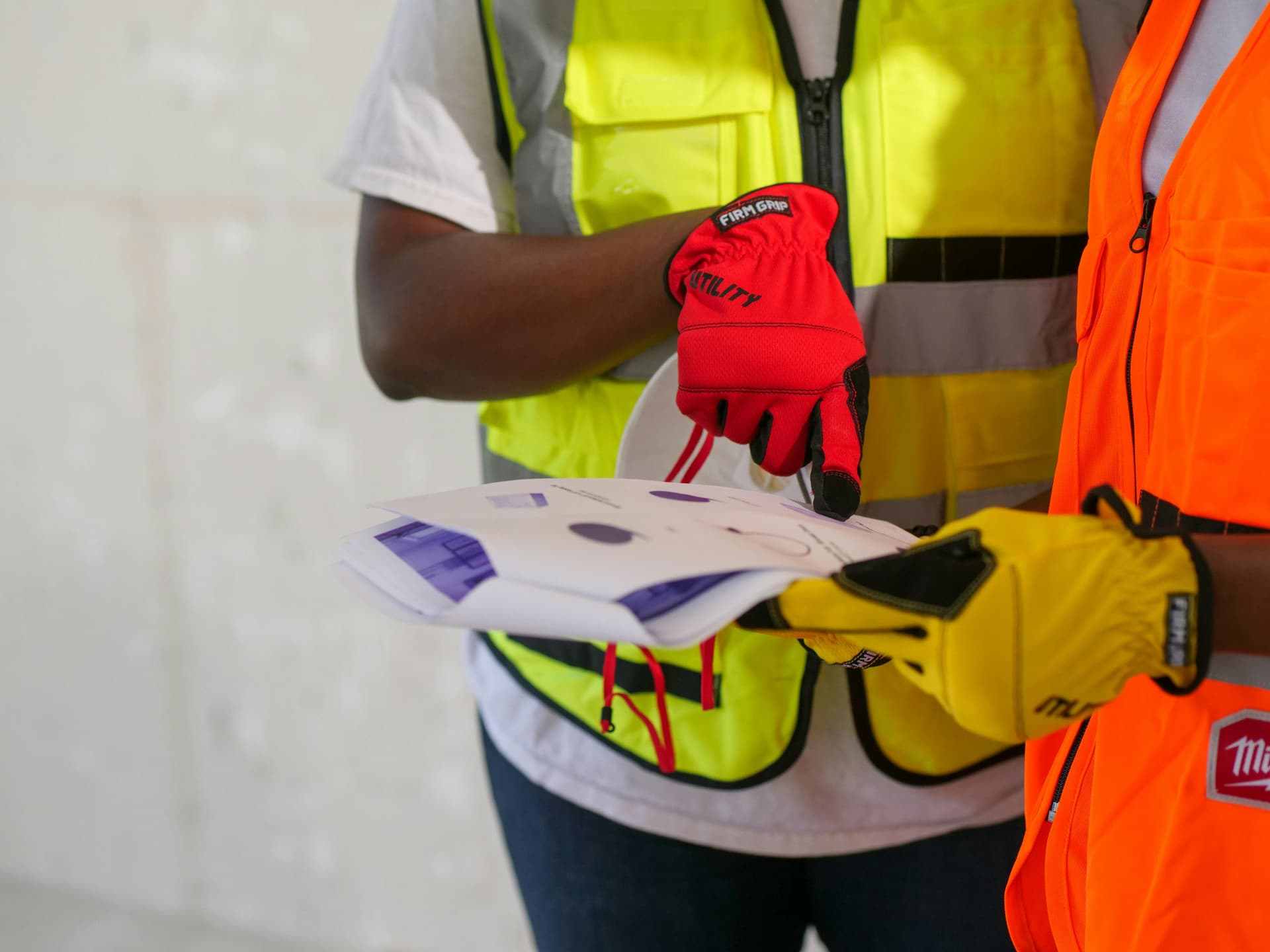

Managing health and safety across modern operations can look deceptively well controlled. Policies have been reviewed, statutory certifications are displayed in reception, risk assessments sit filed on corporate servers and recent board packs show no headline-grabbing RIDDOR incidents. At executive committee level, the dashboard is reassuringly green.
Yet without a rigorous, independent workplace health and safety audit, that apparent control is often an illusion.
When experienced safety consultants step out onto the operating floor, whether that means manufacturing lines, regional distribution centres, engineering workshops or high street retail units, a different reality often emerges:
- An emergency fire exit wedged open with a timber pallet to improve ventilation during a busy shift.
- Interlocks and machine guards carrying subtle, undocumented workarounds that operators have engineered to shave seconds off cycle times.
- Forklift pre-use inspection sheets signed off in batches at the start of the week rather than completed before each shift.
- Contractor permits to work treated as administrative formalities, signed from an office desk without any physical check of isolation points or work at height arrangements.
This is the operational gap between Work as Imagined (WAI), the clean, linear world described in safety manuals and board reports, and Work as Done (WAD), the improvised, high-pressure compromises people make on the ground to get the job done.
Most organisations do not suffer from a shortage of health and safety paperwork. Many are drowning in it. What they lack is an accurate, objective understanding of their real level of operational control.
When senior leaders confuse documentation with protection, they overestimate their safety posture. This guide explores why that gap develops, how a structured 70-question benchmark framework cuts through subjective self-reporting, and how forward-thinking leaders turn audit findings into a live, executive-level roadmap rather than an unread 80-page PDF.
The Illusion of Control: Work as Imagined vs Work as Done
Every business operates with two parallel health and safety realities.
The first is Work as Imagined. It lives in management systems, method statements, ISO frameworks and board presentations. It assumes that plant is always operational, that staffing levels never dip below plan, that people are never fatigued, that contractors read every page of their induction and that every task is carried out exactly as documented.
The second is Work as Done. In the real world, supply chains are delayed, shift handovers are rushed, machinery develops intermittent faults and people adapt. Frontline teams do not take shortcuts out of malice or laziness. They adapt because they are invested in keeping the operation moving. Over time, those daily adaptations become routine habits, a pattern known as the normalisation of deviance.
The danger comes when executive teams base governance solely on Work as Imagined. When a serious incident occurs, the reaction is often disbelief: how could this happen when we had a detailed risk assessment for that exact activity?
A risk assessment that exists only in a folder does not isolate electrical energy, prevent a fall through a fragile rooflight or stop a vehicle striking a pedestrian in a congested yard. Real control exists only where documented expectations and everyday practice line up. Closing that gap means leaders stop asking whether a policy exists and start asking what actually happens when no one is looking.
The Flaws of Subjective Site Reporting
If the gap between policy and practice is so common, why does it rarely show up in monthly management reports? In multi-site organisations, whether that means four facilities or forty, board-level visibility is usually weakened by three problems in traditional reporting.
The watermelon effect
Most executive safety packs suffer from watermelon reporting: vibrant green on the outside, bright red once you cut into the core. Site and regional managers are understandably judged on operational output, delivery schedules and safety KPIs. When internal audits are self-assessments, there is an unavoidable human instinct to present an orderly operation. Findings are played down, informal workarounds are rationalised as practical arrangements, and minor non-conformances are quietly corrected on the day rather than logged as systemic concerns.
The subjectivity of internal audits
Without an objective, independent scoring method, an internal audit reflects the personality and rigour of the person holding the clipboard.
- A lenient auditor or a busy site lead might award a facility 95% compliant because the paperwork folders are full, despite obvious housekeeping problems and missing machine guarding.
- A meticulous, experienced practitioner at another site might award an unsatisfactory score because they noticed inconsistent lock-out/tag-out practice during a night shift.
To the managing director or chief operating officer reading the summary, the first site looks like a high performer and the second looks like a problem area. In reality, the first site may be sitting on a latent catastrophe while the second is actively managing its risks.
Over-reliance on lagging indicators
Many leadership teams still treat incident rates, such as lost time injury frequency rates or RIDDOR counts, as their primary safety measure. A low injury rate does not prove the presence of safety. It often indicates nothing more than the absence of bad luck.
If people routinely access racking without fall protection, the fact that nobody fell this quarter does not mean the risk is controlled. It means the organisation has been fortunate. Lagging metrics tell you where you were yesterday and offer no insight into where harm is building for tomorrow.
The 70-Question Benchmark Audit Framework
To replace subjective self-reporting with verifiable control, an organisation needs an objective baseline that tests both physical controls and human behaviour. SML's Benchmark Audit was built for that purpose. Rather than applying a generic tick-box questionnaire, it uses a structured 70-question framework that evaluates operational health and safety across four interdependent pillars.
Pillar 1: Leadership and visible ownership
Health and safety performance rarely exceeds the standard set by leadership. This pillar does not ask whether directors have endorsed a safety policy. It asks how leadership behaviour shows up across operating sites.
- Visible leadership in practice. Do directors and operations managers regularly walk the floor and ask open, curious questions, or do they only visit after an incident?
- Safety versus production tension. When commercial deadlines or shipping targets clash with safety controls, what message do supervisors actually give?
- Accountability without fear. Do managers take clear ownership of safety actions, or are responsibilities routinely passed to outsourced contractors or central advisers?
- Competence at board level. Are directors aware of their specific legal duties under the Health and Safety at Work etc. Act 1974, and do they receive competent, unfiltered advice?
Pillar 2: Management systems and practical arrangements
A management system should make compliance easier and reduce confusion, not add bureaucratic friction. This pillar tests whether the framework genuinely supports safe working.
- Proportionate documentation. Are safe systems of work and standard operating procedures concise, accessible and written in plain English, or are they unreadable 60-page manuals that frontline staff avoid?
- Statutory compliance and plant maintenance. Are mandatory inspections such as PUWER, LOLER, PSSR, LEV and fixed wire testing current, tracked and linked to planned preventive maintenance?
- Contractor control. Are third-party contractors vetted, formally permitted and monitored on site, or does oversight stop at the security gate?
- Emergency preparedness. Are emergency procedures realistic given actual staffing levels, operating hours and site geography, including non-routine shifts and lone-working windows?
Pillar 3: Culture, communication and trust
Culture governs what happens when management leaves the room. Where trust is broken, procedures get ignored. This pillar looks at the psychological and cultural environment.
- Blame versus learning. When something goes wrong, does the investigation seek to blame an individual, or to understand the conditions that made the error likely?
- Near-miss reporting. Do employees report near misses and early warnings, or is reporting suppressed by targets, disinterest or fear of reprisal?
- Employee consultation. Are frontline teams involved in reviewing risk assessments and shaping safe systems of work, or are controls imposed from the top down?
- Supervisory tone. How do supervisors set the daily tone at pre-shift briefings and handovers? Are safety moments built in naturally, or rushed through as an afterthought?
Pillar 4: Physical risk control and critical safeguards
This pillar focuses on the high-consequence hazards that can cause life-changing injury or death, testing physical conditions on the ground against the documented standard.
- Machinery safety and isolation. Are guarding, emergency stops and lock-out/tag-out protocols maintained and followed during cleaning, maintenance and unjamming?
- Workplace transport and pedestrian segregation. Is there proper physical segregation between pedestrians and moving plant, including forklifts, heavy goods vehicles and automated equipment?
- Work at height. Are risks from roof access, mezzanine edges, vehicle loading bays and maintenance tasks eliminated where possible, or controlled with certified, inspected equipment?
- Dangerous substances and fire safety. Are flammable liquids, combustible dusts (DSEAR) and chemicals controlled, ventilated, segregated and zoned with verified ATEX-rated equipment?
Multi-Site Audits: Turning Operational Risk into an Objective KPI
For multi-site directors, one of the most frustrating parts of health and safety governance is the inability to compare like with like. Because every question in the framework is scored against a standardised, evidence-based rubric, the audit produces a single comparable Benchmark Score (0 to 100%) for each facility. That turns health and safety from a vague compliance conversation into a usable management metric.
1. Instant strategic clarity
Leaders can see at a glance where systemic strength sits and where acute vulnerability exists. Instead of spreading capital spend evenly across every site, investment can be directed into specific areas of failure, whether that is supervisory leadership training at one depot or machine guarding upgrades at another plant.
2. Eliminating the illusion of uniformity
In groups that have grown through acquisition, standards are rarely uniform. Facilities keep legacy practices, different contractor systems and divergent safety cultures. The Benchmark Audit provides an independent, unvarnished baseline across every operating unit, setting an equitable standard for what good looks like across the group.
3. Evidencing continuous improvement
Run annually, the score gives leadership and board members a clear measure of improvement over time. It also provides tangible evidence to insurers, enforcing authorities and ESG auditors that the organisation actively measures, monitors and reduces its operational risk profile.
Killing the 80-Page PDF: Driving Action Through SML Connect
Traditional safety auditing has a delivery flaw: the 80-page static PDF. Weeks after an audit, a large document lands in an operations director's inbox. It is dense, repetitive and padded with boilerplate legislation. Buried on page 63 is a critical observation about a failing safety interlock on a primary conveyor line, listed next to a trivial note about a missing sign on a cleaner's cupboard.
The report gets skimmed, forwarded to an already stretched site manager, filed in an email folder and largely forgotten. When an insurer or enforcing authority asks for progress six months later, nobody can prove what was actioned.
An audit is only worth the operational change it creates. That is why the Benchmark Audit replaces traditional reporting with two executive deliverables.
1. The one-page executive dashboard
Senior leaders do not have time to wade through hundreds of pages of technical narrative. We provide a clear, concise One-Page Executive Summary that highlights:
- The site's overall Benchmark Score and the breakdown across the four pillars.
- The top three organisational strengths identified during the audit.
- The top three critical priorities that need immediate executive backing and capital resource.
- A risk velocity trajectory comparing current standing with previous audits.
2. Live action management in SML Connect
Audit findings should never live in static documents. Every observation, piece of evidence and corrective recommendation is delivered through SML Connect, our digital management platform, where findings become a live operational roadmap:
- Assigned ownership. Every corrective action has a designated owner and an agreed, realistic completion date.
- Real-time visibility. Executive leadership can log in at any point and see close-out rates across every facility in the group.
- Audit-ready evidence. When an action is completed, site teams upload photographic proof, sign-offs or updated assessments, creating a clear compliance trail for board audits or HSE visits.
- No more lost spreadsheets. Cross-departmental progress is visible, which removes the friction of chasing updates across email threads and separate trackers.
Conclusion: From Passive Reassurance to Active Confidence
Health and safety excellence does not come from having the thickest policy or the quietest incident log. It comes from the humility to accept that Work as Imagined and Work as Done rarely match, and from the leadership commitment to find out why.
The 70-question Benchmark Audit removes the guesswork, strips out subjective site bias and gives an honest view of how your controls perform under operational pressure. Combined with SML Connect, it turns safety management from a reactive administrative task into a strategic driver of operational performance.
If you are ready to move beyond green on paper, our team of safety advisers can help. Speak to us about a Benchmark Audit, or call us on +44 (0)1327 311300 to discuss your sites. You can also read more about how benchmark audits work.
Frequently Asked Questions
What is the difference between a compliance inspection and a Benchmark Audit?
A compliance inspection normally looks at whether your organisation meets the minimum baseline required by health and safety legislation at a particular point in time. SML's Benchmark Audit goes further. It evaluates the operational effectiveness of the whole safety management system, testing leadership engagement, workforce culture, procedural clarity and physical critical risk controls through an objective 70-question framework. It does not just ask whether you comply. It tests how resilient your controls are under operational pressure.
How does the Benchmark Audit identify the difference between Work as Imagined and Work as Done?
Our senior consultants spend minimal time reviewing paperwork in offices and the majority of their time where work actually happens: on the shop floor, at the loading bay or on the production line. They hold open, non-punitive discussions with operators, observe real shift handovers, review non-routine maintenance activities and inspect physical safeguards. Comparing documented procedures with day-to-day practice exposes the informal workarounds and latent hazards that traditional audits miss.
Can the Benchmark Score be compared across different sectors?
Yes. The specific operational risks differ between manufacturing, warehousing, retail and engineering, but the core principles of leadership, systematic control, workforce trust and physical safeguard integrity hold across all of them. The framework gives multi-site operations and group businesses a standardised, comparable percentage score across every operating unit, so executive teams can see group-wide trends and allocate resources where they are needed.
How long does a Benchmark Audit take?
A standard single facility usually involves a one-day on-site assessment by a senior consultant, followed by the Executive Dashboard and the action roadmap in SML Connect. Multi-site programmes are tailored to the scale of the group and are often rolled out in phases across regional clusters.
How does SML Connect help internal teams manage post-audit actions?
Rather than handing over a static PDF, SML Connect converts every finding into a live, trackable task. Site managers receive action items with target dates, can assign sub-tasks and upload verification evidence such as photographs, training sign-offs or maintenance sheets. Senior leadership keeps real-time visibility of close-out rates across every site from a single dashboard.
Ready to know your real risk level?
An independent benchmark score shows where your organisation stands, removes operational blind spots and turns health and safety into a genuine business strength. Book a consultation with our advisory team or call +44 (0)1327 311300 to discuss an approach tailored to your sites.